01
Ductile fracture and failure of marine steels
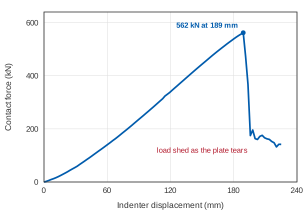
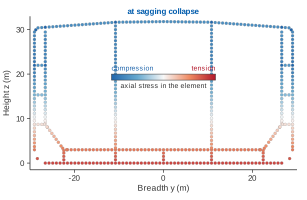
The lab's longest-running line. We measure how shipbuilding and offshore steels deform, neck and fracture under large strain, calibrate fracture models against that data, and implement them as user material subroutines so the models can be used in the explicit finite element analyses that structural assessment actually relies on.
Current work includes
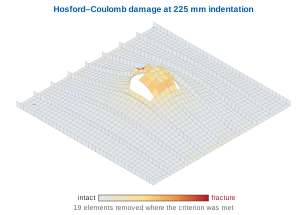
- Calibration of ductile fracture models (Hosford-Coulomb, GTN, BWH instability criteria) for shipbuilding and high-tensile steels
- User material subroutines (VUMAT) for shell and solid elements, including the mesh-size regularisation that shell fracture prediction depends on
- Localised necking as a separate failure mechanism from fracture, and the strain rate and thermal softening effects that govern it
- Material testing across stress states and temperatures, down to sub-zero service conditions
Evidence from the publication record
- (2020). Rate-dependent combined necking and fracture model for predicting ductile fracture with shell elements at high strain rates. International Journal of Impact Engineering 146: 103697.
- (2020). On the prediction of ductile fracture in ship structures with shell elements at low temperatures. Thin-Walled Structures 151: 106721.
- (2021). Evaluation of localized necking models for fracture prediction in punch-loaded steel panels. Journal of Marine Science and Engineering 9(2): 117.
- (2020). Comparative study on ductile fracture prediction of high-tensile strength marine structural steels. Ships and Offshore Structures 15(sup1): 208–219.
- (2020). Ductile fracture behavior of mild and high-tensile strength shipbuilding steels. Applied Sciences 10(20): 7034.